Malaysia’s Najib moved from prison to house arrest after royal clemency
Najib, 73, was jailed for his role in one of the largest global plunders of a sovereign wealth fund, the now-defunct 1MDB.
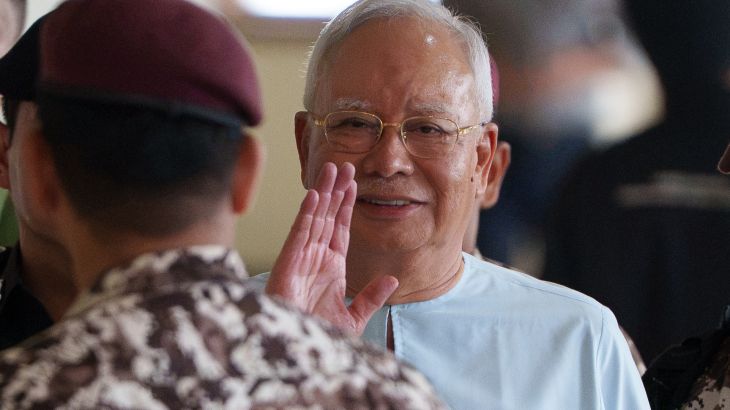
Malaysia’s ex-PM transferred to house arrest for 1MDB graft sentence
Malaysia’s former Prime Minister Najib Razak has been transferred from prison to his home to serve the remainder of his sentence for his role in the 1MDB scandal, one of the largest financial frauds in history.
Najib, 73, reached his residence in Kuala Lumpur late on Tuesday, in a vehicle escorted by prison trucks, police cars and motorcycles.
Recommended Stories
list of 3 items- list 1 of 3Malaysian ex-PM Najib Razak found guilty in 1MDB trial: What we know
- list 2 of 3Malaysian court rejects Najib’s bid to serve sentence under house arrest
- list 3 of 3Malaysia’s ex-PM Najib found guilty of money laundering, abuse of power
The former prime minister had been in prison since August 2022 for his role in the theft of billions of dollars from the now-defunct 1MDB, a state investment fund he co-founded while in power.
In September, Najib was granted royal clemency, allowing him to serve the rest of his sentence under house arrest once he paid a court-imposed fine. It was his second sentence reduction, after a previous king halved his original 12-year sentence.
Najib will now remain confined to his home until August 2028, when that sentence ends.
One of Malaysia’s most influential and divisive figures, Najib has consistently denied wrongdoing and maintains he was made a scapegoat for the globe-spanning scheme that US investigators say siphoned off about $4.5bn from 1MDB.
Prosecutors have said more than $1bn ended up in accounts linked to him.
Last Friday, he left prison after his political party paid the 50 million ringgit ($12.3m) fine, but he was brought back hours later after the attorney general blocked the transfer, seeking legal clarifications.
The request drew a public rebuke from the palace. In a statement, it said King Sultan Ibrahim Iskandar’s prerogative of pardon for Najib that allowed the house arrest was clear and must be respected. It said any attempts to challenge it would amount to defying the royal order.
The king, a position held in rotation by Malaysia’s nine regional state rulers, plays a largely ceremonial role but has the authority to grant pardons under discretionary powers granted by Malaysia’s Constitution.
The Kuala Lumpur High Court cleared the final legal hurdles for Najib’s transfer earlier on Tuesday.
Al Jazeera’s Rob McBride, reporting from outside the court in Kuala Lumpur, said Najib’s release has caused “all manner of political and constitutional controversy” in Malaysia.
“The king made it plain he wasn’t happy with the interference of the attorney general over the weekend, and that it set a very difficult precedent,” McBride said, adding that the move underlines the complicated, delicate relationship between the monarchy, the courts and the government.
After the ruling, Home Minister Saifuddin Nasution Ismail urged all parties to “handle the matter maturely and responsibly”.
“This is a high-profile case with significant political implications and public perception,” he said in a statement. “They should not let political polemics undermine the people’s confidence in the nation’s institutions.”
The house arrest order applies only to Najib’s first conviction.
He faces an additional 15 years in prison after being found guilty last year in another 1MDB-linked case, with the sentence set to begin after his stint under house arrest ends.
Najib has appealed the case, and his lawyers requested that the jail term and fines be halted, citing his poor health and inability to pay the fine.